


What is Welding Procedure Qualification
Welding process evaluation is a key link in ensuring welding quality. It provides a reliable basis for actual welding production through systematic verification of welding process. The following is a detailed introduction from the aspects of definition, purpose, process, standards and applications:
1. Definition of welding process evaluation
Welding process evaluation refers to the test process and result evaluation conducted to verify the accuracy of the proposed welding process. It is a verification test conducted on the welding process in the preliminarily formulated welding process in the welding process details card or other regulations before the product is formally welded. By welding test pieces, testing samples, and examining whether the performance of the welding joint meets the technical conditions of the product, in order to evaluate whether the welding process is qualified.
2. Purpose of welding process evaluation
Ensure welding quality: Verify whether the welding process can obtain welding joints that meet the requirements in actual production (such as mechanical properties, corrosion resistance, etc.).
Guide production: Provide reliable technical basis for formulating formal welding process regulations or welding process cards to avoid product quality problems due to improper process.
Meet the standards and regulatory requirements: Welding process evaluation is mandatory in many industries (such as pressure vessels, pressure pipelines, ships, aerospace, etc.) to ensure the safety and reliability of the product.
3. Basic process of welding process evaluation
(I) Preparation
Clarify evaluation requirements: according to the product's design requirements, use environment and related standards (such asASME, ISO, GB, etc.), determine the specific indicators for welding process evaluation (such as strength, toughness, welded joint form, etc.).
Formulate welding process: Preliminary formulation of welding process parameters, including:
Welding methods (such as manual arc welding, gas protective welding, submerged arc welding, etc.);
Material and specifications of the base material (such as steel grade and thickness);
Welding materials (models and specifications of welding rods, wires, fluxes);
Welding parameters (welding current, voltage, welding speed, preheating temperature, postheating temperature and insulation time, etc.);
Connector form (butt, angle connection,T-connection, etc.) and bevel design.
(II) Preparation of welding specimens
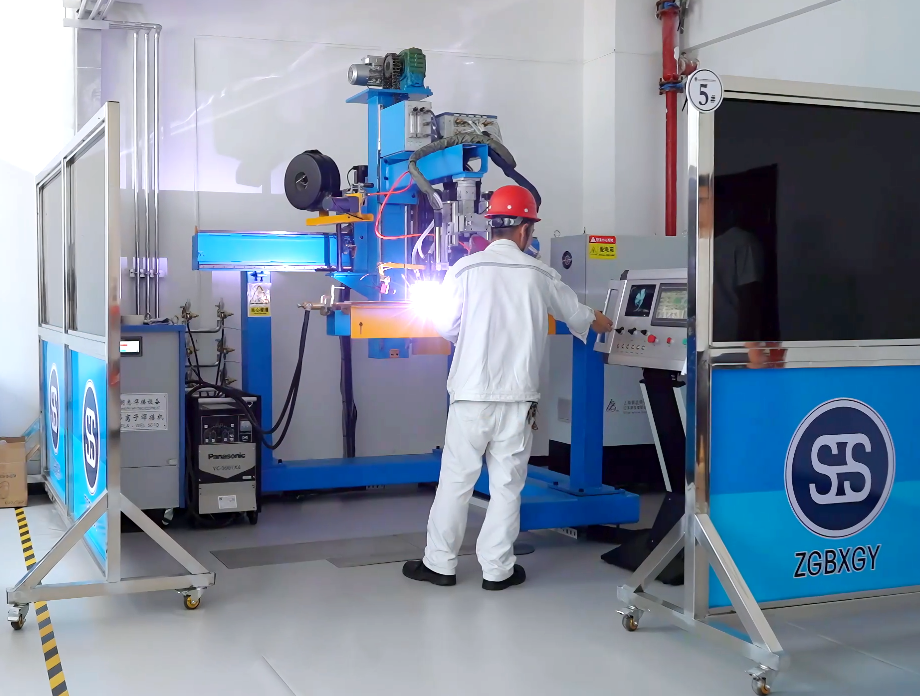
Welding is carried out on test pieces that meet the requirements according to the proposed process parameters. The material, specifications and welding positions of the specimen (such as flat welding, vertical welding, horizontal welding, and overhead welding) must be consistent with the actual product or be representative.
(III) Testing
Appearance inspection: Check whether the surface of the weld is damaged by cracks, pores, slag inclusion, unwelded penetration, and whether the weld size meets the design requirements.
Non-destructive testing: Common methods include ray detection (RT), ultrasonic detection (UT), magnetic powder detection (MT), permeability detection (PT), etc. are used to detect defects inside the weld.
Mechanical properties test:
Tensile test: Determine the tensile strength and yield strength of the welded joint.
Bending test (surface bend, back bend, side bend): Check the plasticity of the welded joints and evaluate the crack resistance of the weld and heat-affected zones.
Impact test: Determine the toughness of welded joints under impact load, especially low-temperature toughness.
Hardness test: Test the hardness distribution of each area of the welded joint (weld, heat-affected zone, base material) and evaluate its performance uniformity.
Other special inspections: According to product requirements, corrosion resistance tests, fatigue tests, intergranular corrosion tests, etc. may also be required.
(IV) Results Assessment and Report Preparation
If all test results meet the standard requirements, the welding process will be evaluated as qualified and the Welding Process Evaluation Report will be prepared (Welding Procedure Qualification Report, WPQR), and formulated the Welding Procedure Specification (WPS) based on this.
If the inspection results fail, the cause needs to be analyzed, the welding process parameters need to be adjusted, and the evaluation must be carried out again until it is passed.
4. Application scenarios for welding process evaluation
Manufacturing: pressure vessels, pressure pipelines, storage tanks, ship hulls, bridges, steel structure buildings, etc.
Energy industry: nuclear power plant equipment, oil and gas pipelines, wind power equipment (such as tower welding).
Aerospace and national defense: aircraft fuselage, engine components, rocket shells, and other areas that require extremely high welding quality.
Machinery manufacturing: heavy machinery, vehicle parts (such as frame welding), etc.
5. precautions for welding process evaluation
Coverage range of process parameters: In actual application of welding processes that have passed the assessment, the parameters must fluctuate within the allowable range of the assessment (such as the deviation range of current and voltage), and must be re-evaluated if they exceed the range.
Matching of base material and welding materials: Different materials of base material (such as carbon steel and stainless steel), and different specifications of welding materials (such as welding rod diameter) may require separate evaluation.
Welding personnel qualifications: Welders participating in the assessment must have the corresponding qualifications, and the welders in actual production must operate according to the process of passing the assessment.
Regular review: When there are major changes in welding processes, materials or equipment, a review is required; some industry standards also require regular review of process assessments (such as every certain period).
6. the significance of welding process evaluation
The core of quality control: Ensure the performance of welded joints from the source and reduce the risk of product failure.
Improve production efficiency: Avoid rework and scrapping caused by process problems, and reduce cost losses.
Promote technological innovation: Promote the technological progress of the industry through assessment and verification of the applicability of new welding processes and new materials.
Through strict welding process evaluation, welded structures can be ensured to be safe and reliable during service, which is an indispensable quality assurance link in modern industrial production.
Common metallographic structure of steel
Stainless steel weld X-ray flaw detection technology


