


Multivariate balance phase diagram related to stainless steel welding
In the field of stainless steel welding, balanced phase diagrams are the core theoretical tools for interpreting phase change laws, predicting microstructures, and optimizing process parameters. Although stainless steel base material and filler metal often contain more than ten alloy elements, and during weldingThe extreme thermal cycle of "rapid heating - high temperature melting - rapid cooling" forms unequal conditions, resulting in the standard phase diagrams that can only approximate the prediction of weld structure, but with the help of thermodynamic calculation procedures, customized phase diagrams built on precise data can provide quantitative guidance for stainless steel welding. Among them, Fe-Cr binary phase diagram, Fe-Cr-C ternary phase diagram, and Fe-Cr-Ni ternary phase diagram are the three core foundations. They support the welding process design of ferrite, martensite, austenite and duplex stainless steel, which directly determine the structural stability and service reliability of the joint.
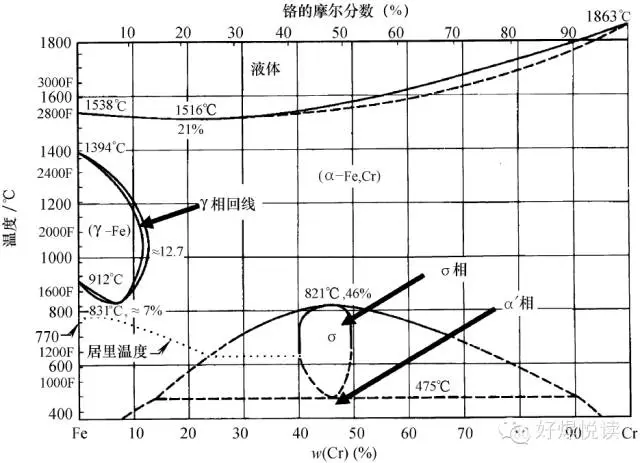
The Fe-Cr binary phase diagram is the starting point for understanding the phase balance of stainless steel, because the phase change law of its core alloy element chromium is revealed entirely by this diagram. The most critical feature of this phase diagram is the "γ phase reticle" - in the temperature range of 912~1394℃, low-chromium content alloys will form an austenite region, and the chromium content directly determines the high-temperature structure: when the chromium content is ≤12%, the alloy is fully austenite in this temperature range, and it can be converted into martensite after rapid cooling. This is the basis for the high-strength structure that can be obtained through quenching after welding; when the chromium content is between 12%~12.7%, a mixed structure of austenite and ferrite will be formed at high temperature. The cooling rate must be controlled during welding to avoid tissue segregation; when the chromium content is ≥12.7%, it is all ferrite at high temperature, and welding needs to avoid excessive heating temperature and causing coarse grains. In addition, the Fe-Cr phase diagram also clarifies the risks of two low-temperature embrittlement phases: one is the σ phase. The Fe-Cr compound in this tetragonal crystal structure slowly forms when the chromium content is > 20%, and the temperature is 600~800℃. It has high hardness and high brittleness, which will seriously reduce the toughness of the joint. Therefore, ferrite or duplex stainless steel needs to be cooled quickly after welding to skip this temperature range; the other is the α′ phase, near 475℃, alloys with chromium content > 14% will cause "475℃ embrittlement" due to the precipitation of chromium-rich co-precipitates. The welded stainless steel components need to avoid serving in the 400~540℃ temperature range for a long time to prevent brittlement failure.
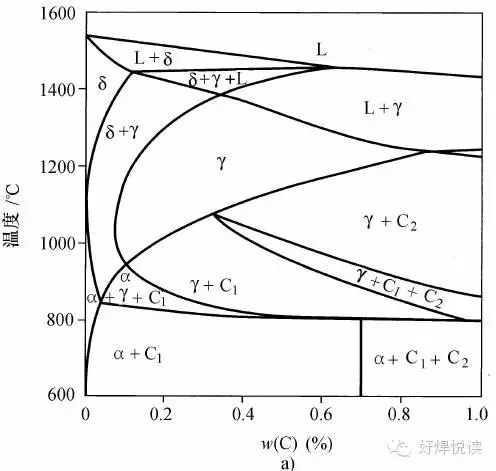
The Fe-Cr-C ternary phase diagram is the key to the welding process design of martensite and ferrite stainless steel, because carbon, as a strong austenite forming element, will significantly change the phase balance of the Fe-Cr system, expand the γ-phase loop area, and allow high chromium alloys to stabilize austenite at high temperatures. To simplify the analysis, a "pseudo-binary phase diagram" with fixed chromium content (such as Fe-C cross-section with 13% chromium content) is usually used, which can clearly show the impact of carbon on the tissue. Take the pseudo-binary phase diagram with 13% chromium content as an example: When the carbon content is less than 0.1%, the alloy is full ferrite at high temperature, and the ferrite structure can be retained after rapid cooling. This is the basis for maintaining good corrosion resistance after welding of ferrite stainless steel; when the carbon content is higher than 0.1%, a mixed structure between austenite and ferrite is first formed at high temperature, and after cooling below 1200℃, it completely transforms into austenite. After rapid cooling, martensite is formed. This is the basis for the increase in strength through "quenching + backtemper" after welding of martensite stainless steel. At the same time, the Fe-Cr-C phase diagram also shows that after adding carbon, two types of carbides will be precipitated - (Cr,Fe)₂₃C₆ and (Cr,Fe)₇C₃, especially high chromium alloys. The ferrite phase region is expanded and a higher carbon content is required to form austenite. If the carbon content is improperly controlled during welding, it is easy to cause carbides to precipitate at the grain boundaries and cause intergranular corrosion. Therefore, the phase diagram needs to be accurately matched to the ratio of carbon to chromium, and balance strength and corrosion resistance.
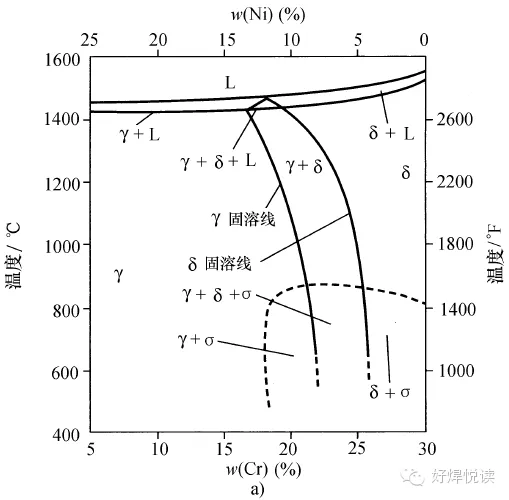
The Fe-Cr-Ni ternary phase diagram is the core theoretical support for the welding of austenite and duplex stainless steel. As an austenite stabilizing element, nickel can expand the austenite phase region and keep it stable at room temperature. This characteristic is the structural basis of austenite stainless steel such as 304 and 316, and duplex stainless steel such as 2205. The liquid and solid phase projection diagrams of this phase diagram can clearly interpret the solidification behavior of the alloy: the thick black curve in the liquid phase projection diagram divides the alloy into two areas: "initial precipitation ferrite" and "initial precipitation austenite". There are ternary eutectic points close to the 48Cr-44Ni-8Fe component point, which will form a special eutectic structure when solidified; the two thick black curves in the solid phase projection diagram are the biphasic regions of austenite and ferrite. The arrow direction represents the temperature drop trend, and the biphasic proportion can be controlled through component adjustment during welding. The pseudo-binary phase diagram with fixed iron content (such as Cr-Ni cross-section with 70% iron content) is more intuitive: the triangular region between the solid phase line and the liquid phase line is the "austenitic + ferrite + liquid phase" three-phase region. The alloy on the left remains austenite after solidification, and the alloy on the right is mainly ferrite after solidification. For duplex stainless steel, the components need to be close to the right boundary of the three-phase zone. Ferrite is first precipitated at high temperature. During the cooling process, part of the ferrite is converted into austenite, and finally a 1:1±10% austenite biphasic structure is formed. If the components deviate from this range, it will lead to excessive ferrite (decreased toughness) or excessive austenite (insufficient strength). During welding, the Cr/Ni ratio must be strictly controlled based on the phase diagram.
As the stainless steel alloy system becomes more complex, the limitations of traditional phase diagrams gradually emerge, andCustomized phase diagrams built by thermodynamic calculation software such as ThermoCalc provide more accurate guidance for special stainless steel welding. In addition, calculating the phase graph can also generate a "phase volume fraction-temperature" curve. The core value of these phase diagrams for stainless steel welding is reflected in"Teachment prediction - defect prevention and control - process optimization - composition matching" Four dimensions: In terms of tissue prediction, the phase composition of the weld and heat-affected zone can be predicted through the phase diagram, such as whether austenite steel will precipitate ferrite and whether duplex steel will have σ phases, avoiding the risk of tissue imbalance in advance; in terms of defect prevention and control, the welding cooling speed can be determined based on the phase diagram to avoid σ phase embrittlement, 475°C embrittlement and intergranular corrosion caused by carbides, and reducing welding cracks; in terms of process optimization, the phase diagram clearly defines the key temperature parameters and guides the setting of welding heat input and post-weld heat treatment parameters; in terms of component matching, the element ratio of the base material to the filler metal can be optimized through the phase diagram, such as the carbon content of martensite steel and the Cr/Ni ratio of duplex steel to ensure that the joint performance matches the base material.
In strict fields such as chemical industry, nuclear power, and marine engineering, the safety and long-term effectiveness of stainless steel welded structures rely entirely on scientific guidance of phase diagrams. Whether it is to avoid intergranular corrosion after welding austenitic steel or to prevent embrittlement after welding duplex steel, the phase diagram is connected.The key bridge of "Composition Design - Process Implementation - Performance Assurance". With the continuous development of thermodynamic computing technology, the guidance of phase diagrams on stainless steel welding will be more accurate, providing more solid theoretical support for the research and development and application of high-end stainless steel welding structures.
The microscopic world of welding--from heat source to molten pool
Understanding the phase diagram of iron-carbon alloys


