


Principle and production process of square steel pipe
In the field of modern industrial manufacturing, square and rectangular steel pipes (collectively referred to as square rectangular pipes) have become indispensable structural materials in the construction, machinery, automobiles, furniture and other industries due to their excellent mechanical properties and processing characteristics. This article will comprehensively analyze the manufacturing technology of square rectangular tubes from multiple dimensions such as molding principle, production process, quality control and development trends.
1. Forming principle and technical characteristics
The production process of square rectangular tubes is mainly divided into two types: direct molding method and round square molding method, each with unique technical characteristics and application advantages.
Direct forming method uses hot-rolled or cold-rolled strip as raw material, and the flat strip is first bent into U and then closed O shape, eventually forming a regular square or rectangular cross-section. In this process, high-frequency induction welding technology plays a key role. It can complete the fused connection of the joints in a very short time, ensuring the stability and reliability of the weld quality. This process is particularly suitable for the production of large-volume, thin-walled square rectangular tubes, with typical product wall thickness ranges from 0.5-12mm Between the cross-sectional dimensions can be 20×20mmto500×500mm No waiting.
In contrast, the circular square forming method uses seamless or welded circular tubes as blanks. Through a carefully designed series of roll groups, the circular cross-sections undergo transitional forms such as ellipses and oblongs, and ultimately transform into the required square or rectangular cross-sections. This process makes full use of the plastic deformation characteristics of metal materials and completes shape conversion while keeping the circumference of the pipe basically unchanged. Since there is no welding process, this process is particularly suitable for wall thickness 1-20mm The thick wall tube production is usually in 10×10mm to 400×400mm Within range.
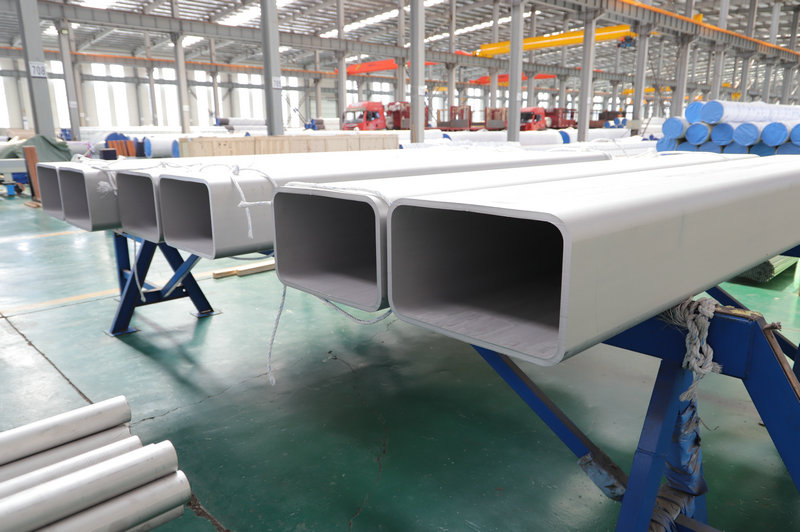
2. Detailed explanation of the production process
In the direct forming process, the complete production line includes several key processes such as unrolling, leveling, roll forming, high-frequency welding, deburring, sizing diameter straightening, cutting inspection, etc. After the uncoiler unfolds the steel coil, the leveler eliminates the internal stress of the material; then, the strip steel gradually completes the shape transformation from plane to three-dimensional through a molding unit composed of more than ten sets of rolls; the high-frequency welding machine applies up to the closed joints.100-400kHz The alternating current uses the skin effect to generate local high temperature to achieve welding; finally, after sizing, straightening and finishing, a finished product with accurate dimensions is obtained.
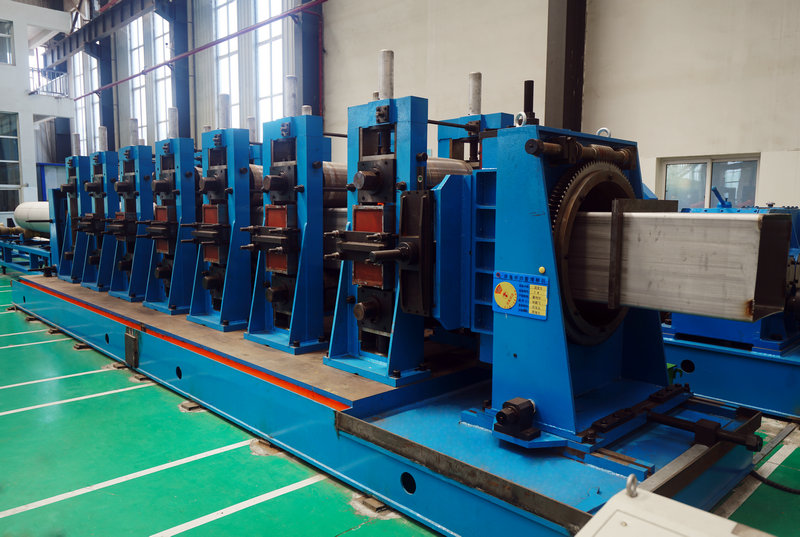
The circular transformation and square forming process pays more attention to the scientific control of the deformation process. Typical 4-8 During the rolling process of passes, the deformation amount of each pass must be accurately controlled at 15% Within, to avoid defects such as cracks in the material. The hole design of the roll is particularly critical, and a progressive transition scheme is required to ensure even stress distribution. In actual operation, a complete lubrication and cooling system is also needed to not only reduce roll wear and prevent pipe surface damage. For special-spec products, sometimes auxiliary means such as medium frequency heating are needed to improve the plasticity of the material.
3. Quality control and FAQs
No matter which process is used, a strict quality control system is indispensable. In direct molding method, welding quality is the focus, and parameters such as welding current, pressure and speed need to be monitored in real time. Common weld defects include incomplete penetration, air holes, slag inclusions, etc., which may affect the structural strength of the product. By optimizing welding parameters, enhancing strip edge cleaning, and adopting advanced online inspection technology, weld quality can be effectively improved.
The round-changing and square forming process requires special attention to deformation uniformity. Corner cracking is the most common quality problem, mainly due to excessive local deformation or insufficient plasticity of the material. This problem can be significantly improved by increasing molding passes, optimizing roll profiles, and appropriately increasing processing temperatures. In addition, dimensional accuracy control is also crucial, and it is necessary to regularly detect roll wear and adjust equipment parameters in time.
4. Technical comparison and selection suggestions
From the perspective of production efficiency, direct molding has obvious advantages, and its continuous production method can achieve every minute 20-50 The production speed of rice is particularly suitable for large-scale manufacturing of standardized products. The round-to-square molding method is more flexible, and can quickly switch different specifications, which is suitable for small batches and multiple varieties of production needs.
In terms of product quality, the dimensional accuracy of direct molding is usually up to the±0.2mm, the surface quality is also better; round square molding products often have ±0.5mmThe dimensional tolerances of left and right, and the corners need to retain certain process rounded corners. In terms of cost, direct forming production lines have a large investment, but the cost of a single piece is low; round square equipment has a relatively small investment, but the cost of raw materials is high.
5. Future development trends
With the transformation and upgrading of manufacturing industry, square tube production technology is developing towards intelligence, precision and green. In terms of intelligence, new technologies such as online detection systems based on machine vision and process optimization algorithms assisted by artificial intelligence are being promoted and applied. The trend of precision is reflected in the continuous shrinking of dimensional tolerances, and some high-end products can already achieve it.±0.1mm level of accuracy. Green manufacturing is manifested in the use of environmentally friendly lubricants, the reduction of energy consumption and the improvement of waste recycling rate.
In addition, the application of new materials also brings new opportunities to the development of square resonance tubes. The adoption of new materials such as high-strength steel and weathering steel has enabled products to make breakthroughs in weight reduction and durability; the development of innovative products such as composite pipes and special-shaped cross-section pipes continues to expand the application boundaries of square rectangular pipes.
6. Conclusion
As a basic industrial material, the progress of square rectangular tubes is directly related to the development of downstream industries. A deep understanding of the characteristics of different molding processes, mastering the key points of quality control, and keeping up with technological development trends is of great significance to improving product competitiveness. In the future, with the continuous emergence of new processes and new equipment, square tubes will surely exert their value in a broader field and provide solid support for industrial development.
Manufacturing process of stainless steel U-shaped tube
Pickling passivation process of stainless steel pipes


