


Common Welding Methods for Stainless Steel Welded Pipe
1.Plasma Arc Welding
Plasma arc welding is a welding method that uses the plasma arc as a heat source. During welding, a high voltage is applied between the tungsten electrode and the workpiece, causing the gas to ionize and form a plasma arc. The plasma arc has an extremely high energy density, which can quickly melt the workpiece and the filler metal. Through precise control of parameters such as the plasma gas flow rate and welding current, high-quality welding can be achieved. Plasma welding has the advantages of fast welding speed, a small heat-affected zone, and small deformation; it can weld thinner plates and pipes, and has unique advantages in the welding of some refractory metals and special stainless steels; the weld quality is high, and there are few internal defects. The disadvantages are that the equipment is expensive, the technical requirements are high, and the cost is relatively high. It is often used in high-end fields such as aerospace and electronics for the welding of stainless steel pipes with extremely high requirements for welding quality and precision, such as the welding of stainless steel pipelines in the fuel system of aircraft engines; and the precision welding of some miniature stainless steel pipes.
2.Argon Arc Welding
Tungsten Inert Gas (TIG) welding is an arc welding method that uses argon gas as a shielding gas. It is divided into Tungsten Inert Gas (TIG) welding and Metal Inert Gas (MIG) welding, which are extremely commonly applied in the welding of stainless steel pipes.
Tungsten Inert Gas (TIG) welding uses a tungsten electrode with a high melting point as the electrode. An arc is generated between the tungsten electrode and the workpiece, and argon gas is ejected from the nozzle of the welding torch to form a protective layer around the arc, preventing harmful gases such as oxygen and nitrogen in the air from invading the molten pool and ensuring the welding quality. During the welding process, the filler metal (welding wire) is added to the molten pool from the side. The advantages are that it can well control the welding heat input, the weld quality is high, the formation is beautiful, and it is especially suitable for welding thin stainless steel pipes; the arc is stable, there is no spatter, and the thermal influence on the workpiece is small, which can reduce the deformation of the workpiece. The disadvantages are that the welding speed is slow, the equipment cost is high, and the environmental requirements are strict. It is often used in industries such as food, medicine, and chemicals for the welding of stainless steel pipes with extremely high requirements for hygiene conditions and welding quality, such as the connection of stainless steel pipelines in pharmaceutical equipment; and the welding of some decorative stainless steel pipes with strict requirements for appearance quality.
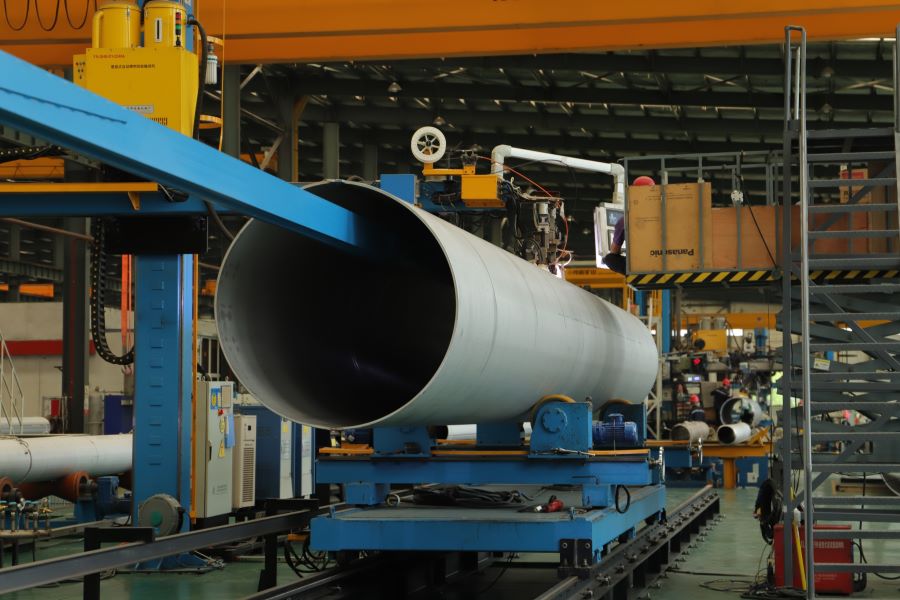
Metal Inert Gas (MIG) welding uses a continuously fed welding wire as the electrode. An arc is generated between the welding wire and the workpiece, and the molten pool is protected by argon gas. Different from TIG welding, the welding wire in MIG welding serves as both the electrode and the filler metal. The advantages are that the current density is large, the deposition rate is fast, it is suitable for welding thick pipes, and the requirement for surface cleaning is low. The disadvantages are that the requirements for equipment and parameter control are high, and welding defects are likely to occur. It is widely used in the welding of medium-thick and thick-walled stainless steel pipes in fields such as machinery manufacturing and building structures, such as the manufacturing of large stainless steel structural parts and the welding of stainless steel pipe trusses in construction projects.
3.Submerged Arc Welding
Submerged arc welding is a welding method in which the arc burns under a layer of flux. When welding stainless steel pipes, it is generally used for the welding of straight seams or circumferential seams. During welding, a layer of granular flux is covered on the surface of the workpiece, and the arc burns under the flux layer, melting the welding wire, the workpiece, and part of the flux to form a molten pool and slag. As the welding process proceeds, the slag floats on the surface of the molten pool, protecting the molten pool and participating in the metallurgical reaction. After the weld solidifies, the slag becomes a slag shell covering the surface of the weld. Submerged arc welding has a large welding current, a large penetration depth, a fast welding speed, and high production efficiency; the weld quality is stable, the surface is smooth, there is no arc radiation during the welding process, and the working conditions are relatively good. The disadvantages are that the equipment is complex, it is only suitable for the flat welding position, and the requirement for assembly precision is high. It is mainly used for the mass production of large-diameter stainless steel pipes, such as the manufacturing of stainless steel pipes for oil and natural gas transmission pipelines; and the welding of the circumferential seams between the cylinder and the head of some large stainless steel containers.
Different welding methods have their own characteristics and application scopes. In the actual welding of stainless steel pipes, factors such as the material, specification, welding position, quality requirements, and production efficiency of the stainless steel pipes need to be comprehensively considered, and the most suitable welding method should be selected to ensure the maximization of welding quality and production benefits. At the same time, with the continuous progress of science and technology, welding technology is also continuously innovating and developing, and new welding processes and equipment are constantly emerging, bringing more choices and higher quality guarantees to the field of stainless steel pipe welding.
The Application of PAW+TIG Hybrid Welding in the Manufacturing of Stainless Steel Pipes
Production Process of Stainless Steel Welded Pipe


