


The Working Principle and Process Parameters of the Seamless Pipe Cold Rolling Mill
The seamless pipe cold rolling mill, also known as the Pilger mill, is a special equipment that uses a chip-free processing technology to produce high-precision metal seamless pipes in the cold state. It can be used to produce high-standard cold-rolled pipes of various materials. Its core working principle is based on the plastic flow characteristics of metals at room temperature, combined with periodic rolling and feeding rotary motion, gradually reducing the diameter and wall thickness and improving the performance of the pipes.
1.Working Principle
The pipe is rolled between a fixed conical mandrel and two ring-shaped rolls. The working stand equipped with a pair of rolls moves horizontally under the drive of the crank-link mechanism. The synchronous gear meshes with the rack, driving the ring-shaped rolls to rotate back and forth while moving together with the stand. The circumferential surface of the ring-shaped roll is provided with a pass with a continuously changing cross-section to achieve the reduction of the billet diameter and wall thickness.
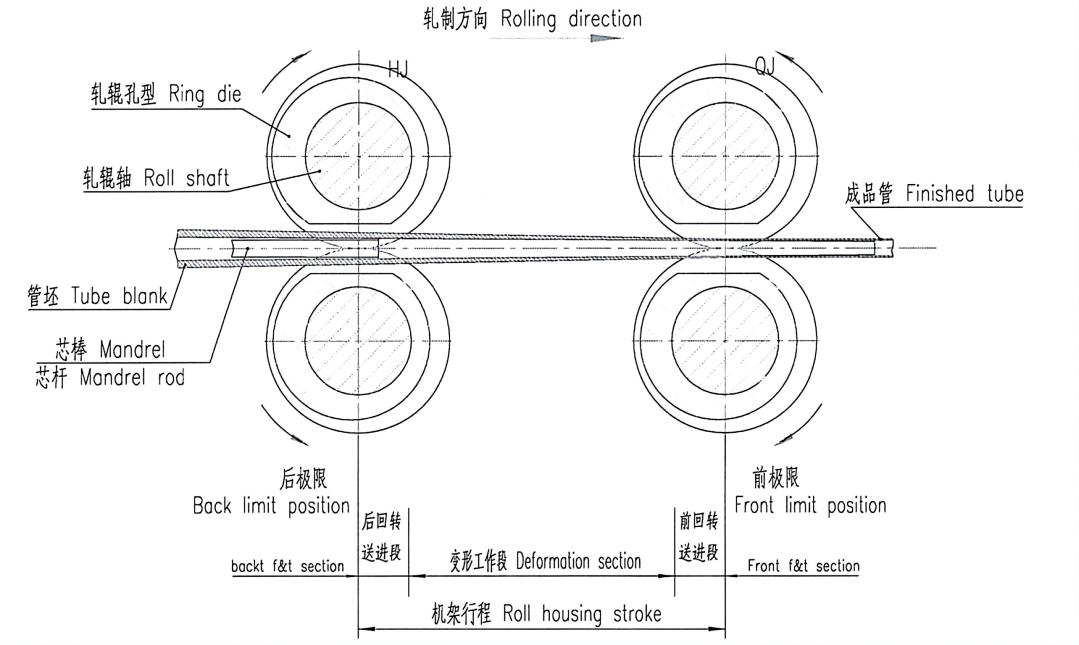
When the working stand reaches the rear limit position, the feeding device and the rotating device respectively drive the pipe billet and the mandrel to rotate and feed. When the working stand moves forward, the fed section of the pipe billet realizes the deformation of diameter reduction and wall thickness reduction in the gradually shrinking annular gap formed by the pass and the mandrel.
When the working stand reaches the front limit position, the pipe billet is fed and rotated again. When the stand returns, the pipe billet completes the diameter reduction, wall thickness reduction or finishing. Each reciprocating motion of the stand completes a rolling cycle, forming a metal deformation working cone. In this way, the rolling process of the pipe billet is realized through periodic work.
2.Process Parameters
The process parameters of the cold rolling mill are the core factors affecting the forming quality, dimensional accuracy and production efficiency of the pipes. The following are the key process parameters of the cold rolling mill:
2.1 Deformation Parameters
(1) Diameter Reduction Rate (ΔD/D): The percentage of the pipe diameter reduction directly determines the degree of plastic deformation of the metal. If it is too small, the metal deformation is incomplete, which is likely to cause uneven wall thickness. If it is too large, it will lead to work hardening, increased residual stress, and even the possible occurrence of cracks.
(2) Wall Thickness Reduction Rate (ΔS/S): The thinning ratio of the pipe wall thickness should match the diameter reduction rate to prevent the occurrence of instability. The ratio (Q value) of the wall thickness reduction rate to the diameter reduction rate needs to be maintained within a reasonable range to ensure the uniformity of deformation. If the Q value is too high, the rolling force may increase sharply, and at this time, corresponding adjustments need to be made in combination with the mandrel parameters.
2.2 Rolling Speed and Feeding Amount
(1) Rolling Speed: The linear speed (m/s) of the roll rotation affects the production efficiency and temperature rise. High-speed rolling needs to be combined with lubrication and cooling to avoid surface defects caused by excessive friction heat. Low-speed rolling is suitable for high-precision thin-walled pipes, but the efficiency is relatively low.
(2) Periodic Feeding Amount (Feeding Amount m): The axial feed amount of the pipe in each rolling cycle determines the single deformation amount. A reasonable feeding amount can reduce the peak value of the rolling force by 10% to 20% and reduce the residual stress.
2.3 Roll and Mandrel Parameters
(1) Roll Clearance (Roll Gap): Controls the final wall thickness and roundness of the pipe.
(2) Mandrel Parameters
Mandrel Taper: Affects the uniformity of metal flow, and the cone angle is usually 1° to 3°.
Mandrel Surface Treatment: Polishing or coating (such as titanium nitride) can reduce friction and extend the service life.
Matching between Mandrel and Roll: The diameter of the mandrel needs to match the roll pass to avoid wall thickness deviation.
2.4 Material Characteristics and Process Adaptation
Stainless Steel (304/316L): It is necessary to control work hardening and adopt low feeding amount and multi-pass rolling. High-viscosity mineral oil is preferably selected as the lubricant to reduce surface scratches.
Titanium Alloy/Zirconium Alloy: With low plasticity, the diameter reduction rate needs to be reduced, and the rolling temperature can be slightly higher than room temperature.
Copper/Aluminum Alloy: With high ductility, a large feeding amount can be adopted, but cooling needs to be strengthened to prevent roll sticking.
2.5 Process Parameter Optimization Method
Numerical Simulation (Finite Element Analysis): Use software such as DEFORM-3D and ABAQUS to predict the stress distribution and defects (error < 10%). Simulate different parameter combinations (such as feeding amount + rolling speed) to screen out the optimal solution.
Conclusion
At present, the cold rolling process technology and equipment level in the world have developed greatly. The cold rolling mill is developing in the direction of high speed, long stroke, ring pass and high precision. In addition, with the development of intelligent and automated technologies, the cold rolling mill is also developing towards greater intelligence and automation. By introducing advanced sensors and control systems, real-time monitoring and precise control of the rolling process can be achieved, further improving production efficiency and product quality. These development trends not only promote the progress of cold rolling mill technology but also inject new vitality into the development of the pipe manufacturing industry.
A Comprehensive Overview of Steel Pipe Knowledge: From Production to Classification
Applications and Technological Breakthroughs of Stainless Steel Pipes in the Military Field


