


Metallographic structure common in steel
Steel, also known as iron-carbon alloy, is iron (Fe) and carbon (C),silicon(Si),manganese(Mn),phosphorus(P),sulfur(S) and a small number of other elements (Cr,VAlloy composed of, etc. By adjusting the content of various elements in steel and the heat treatment process (four fires: quenching, annealing, tempering, normalizing), various metallographic structures can be obtained, so that steel has different physical properties.
After sampling the steel, polishing, and finally corrosion with a specific corrosion agent, the tissue observed under a metallographic microscope is called the metallographic structure of steel. The secrets of steel materials are hidden in these organizational structures.
existFe-Fe3CIn the system, a variety of iron-carbon alloys with different components can be prepared. Their equilibrium structures are different at different temperatures, but they are composed of several basic phases (ferrites).F, austeniteAand cementiteFe3C) composed of these basic phases are combined in the form of mechanical mixtures to form a colorful metallographic structure in steel. There are several common metallographic structures:
- Ferrite
Ferrite (ferrite,abbreviationFN,useFmeans carbon dissolves inα-FeThe interstitial solid solution in the middle has smooth grain boundaries, and there are few twinning or slip lines in the crystal. The color is light green and shiny, and it becomes dark after deep corrosion. Its structure and properties are similar to pure iron, with good plasticity and toughness, but low strength and hardness. Ferrite is also the matrix of pearlite tissue. Ferrite is the main constituent phase in hot rolled (normalized) and annealed structures of carbon and low alloy steels;
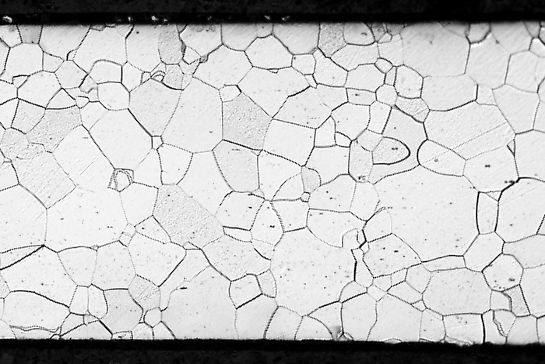
FerriteFerrite
- Austenitic
Carbon dissolves inγ-FeThe gap solid solution formed in the lattice gap is called austenite, with a face-centered cubic structure, which is a high-temperature phase, and is marked with symbols.Aexpress. Austenitic in1148℃Maximum solubility2.11%C,727℃It can be solid and dissolved0.77%C;The strength and hardness are higher than ferrite, have good plasticity and toughness, and are non-magnetic. The specific mechanical properties are related to the carbon content and grain size.
TRIP Steel (change-plastic steel) is a steel material developed based on austenite plasticity and good flexibility. It uses the strain-induced phase change and phase-transform-induced plasticity of residual austenite to improve the plasticity of the steel plate and improve the forming performance of the steel plate. The austenite in carbon or alloy structural steel transforms into other phases during cooling. Only after high-carbon steel and carburizing steel are quenched at high temperature, can the austenite remain in the gap of martensite, and its metallographic structure is white because it is not susceptible to erosion.
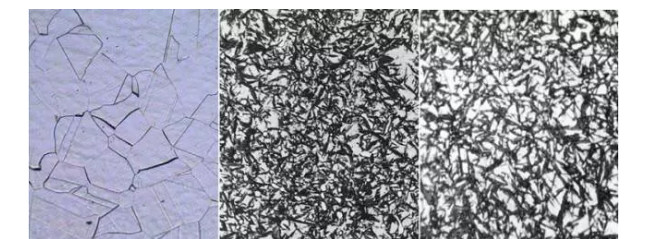
AusteniticAustenite
- Cementite
CementiteIt is a metal compound synthesized by carbon and iron in a certain proportion, using the molecular formulaFe3CIt indicates that its carbon content is6.69%, formed in alloy(Fe,M)3C. It is a gap compound with a complex lattice structure. It is divided into primary cementite (precipitated from the liquid phase), secondary cementite (precipitated from austenite) and triad cementite (precipitated from ferrite). The cementite body is hard and brittle, with almost zero plasticity and impact toughness, very brittle, and hardness800HB. In steel, it is often distributed in network, semi-net, sheet, needle sheet and grain.
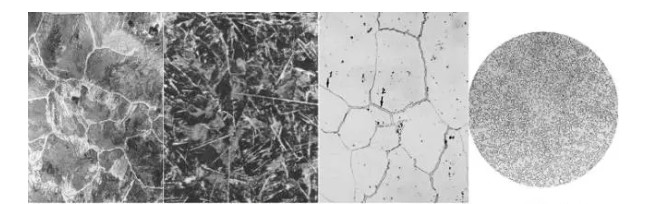
CementiteCementite
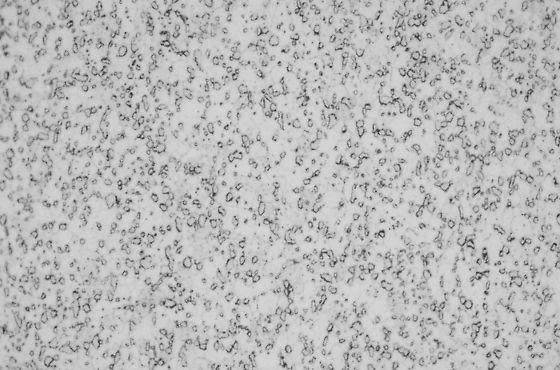
4.Pearl
The mechanical mixture of ferrite and cementite is called pearlite, and is marked with symbolsPexpress. Its mechanical properties are between ferrite and cementite, with high strength, moderate hardness, and a certain plasticity. Pearlite is a product of euthanized transformation of steel, and its form is that ferrite and cementite intersect with each other like fingerprints, arranged in a layered shape. According to the distribution of carbides, it can be divided into two types: sheet pearlite and spherical pearlite.
|
|
|
|
Plate-shaped pearliteLamellar pearlite |
Grained pearliteGranular pearlite |
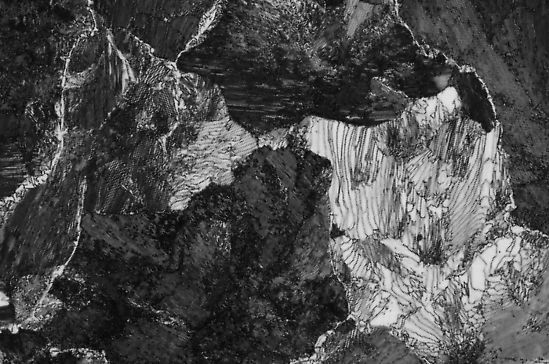
5.bainite
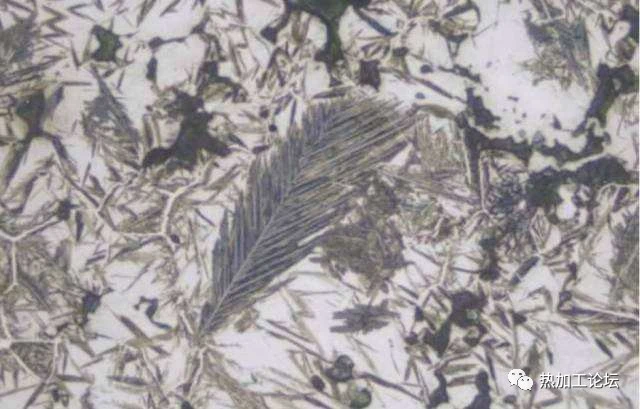
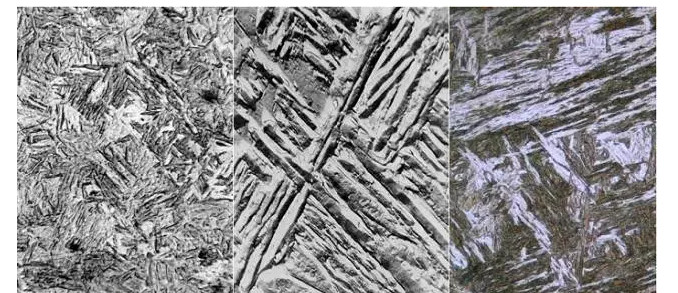
When the austenite is supercooled to a temperature below the pearlite transition temperature and above the temperature zone between the martensite transition temperature, a transition from the shear phase transition and short-range diffusion will occur, and the transformation product is called bainite. Bainite is a mechanical mixture of ferrite and cementite, a structure between pearlite and martensite, with symbolsBexpress. According to the formation temperature, it is divided into granular, upper and lower bainite. Granular bainite has low strength but good toughness; lower bainite has both high strength and good toughness; granular bainite has the worst toughness.
- Upper bainite: Upper bainite is characterized by strip-shaped ferrite arranged generally in parallel, with thin strip-shaped (or thin short rod-shaped) cementite parallel to the ferrite needle axis, which is feather-like.
- Lower bainite: It is in the shape of a fine needle sheet with a certain orientation, which is more susceptible to erosion than quenched martensite, which is very similar to tempered martensite. It is extremely difficult to distinguish under a light microscope and is very easy to distinguish under an electron microscope. Carbides are precipitated in the needle-shaped ferrite, and their arrangement orientation is in the long axis of the ferrite sheet.55~60, the lower bainite does not contain twins and has many dislocations.
- Granular bainite: The shape is equivalent to polygonal ferrite, with many irregular island-like tissues inside.
|
|
|
|
|
Upper bainiteUpper bainite |
DownbainiteLower bainite |
Granular bainiteGranular bainite |
6.Martensite
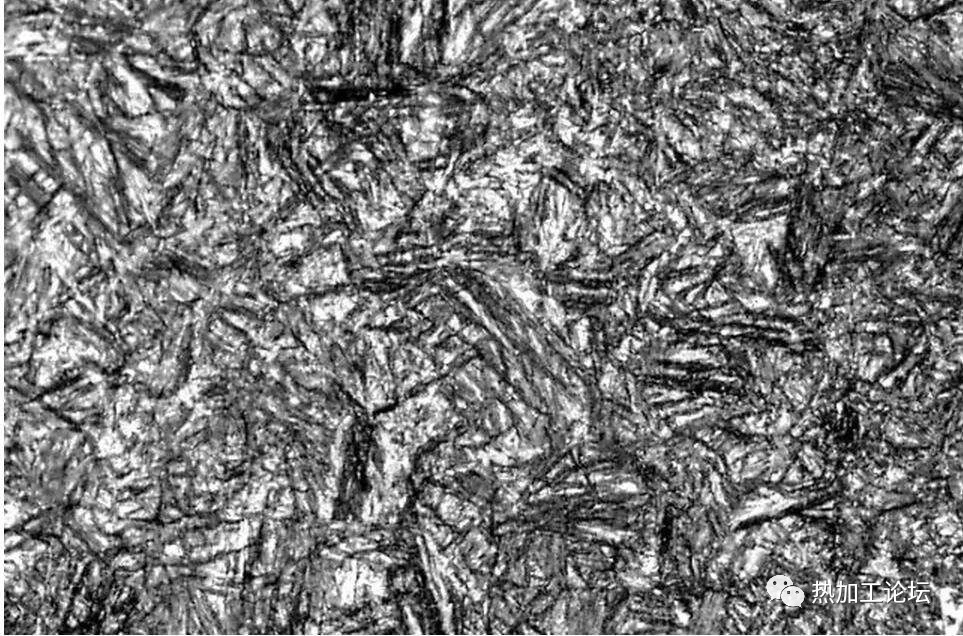
Carbon is inα-FeThe supersaturated solid solution in it is called martensite. The crystal structure of martensite is a quadrangular structure of the body center (BCT), has high strength and hardness, but poor plasticity, almost zero, with symbolsMIndicates that the impact load cannot be withstanded. Martensite is supercooled austenite and rapidly cooled inMs(Martensite transition starting temperature,Martensite Start Temperature)andMf(The end temperature of the martensite transition,Martensite Finish Temperature) The product of the transformation of the shear mode between points. At this time, carbon (and alloy elements) did not have time to spread, just byγ-FeThe lattice (face center) is transformed intoα-FeThe lattice (body heart), that is, carbon inγ-FeThe solid solution (austeinite) is converted into carbon inα-FeThe solid solution in the“No diffusion”of. According to the morphological characteristics of martensite metallographic characteristics, it can be divided into slat martensite and needle martensite.
Slat-shaped martensite: also known as low-carbon martensite. Fine martensite strips of roughly the same size are arranged in parallel to form a martensite beam or martensite field; the positional difference between fields is large, and several fields with different orientations can be formed in a pristine austenite grain. Since the temperature of the slat martensite is formed is high, self-tempering will inevitably occur during the cooling process, and carbides are precipitated inside the formed martensite, so it is susceptible to erosion and darkness.
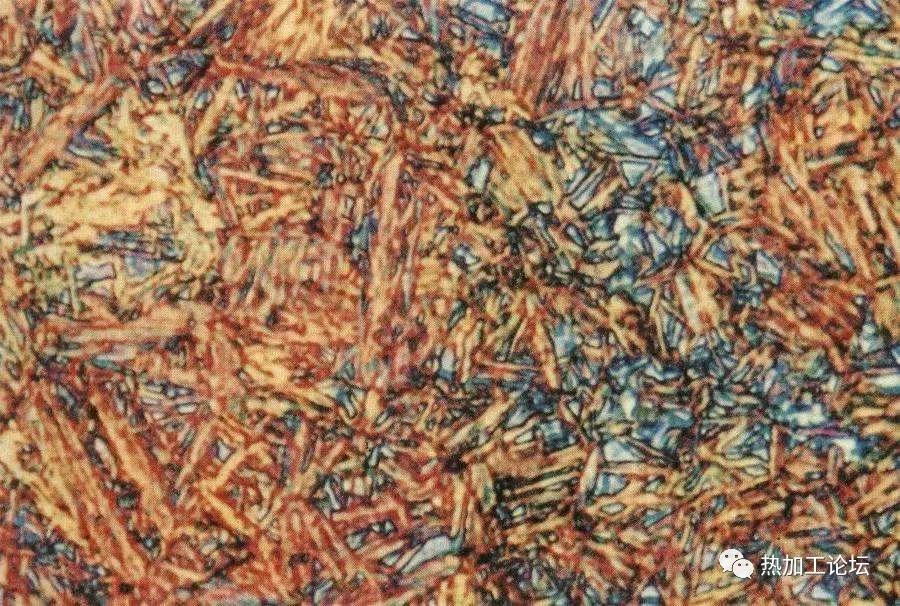
Slatted martensiteLath martensite
Needle martensite: also known as sheet martensite or high carbon martensite. Its basic characteristics are: the first martensite sheet formed in an austenite grain is coarse and often runs through the entire grain, and the austenite grains are divided, so that the size of the martensite formed later is limited. Therefore, the size of the sheet martensite is different and the distribution is irregular.
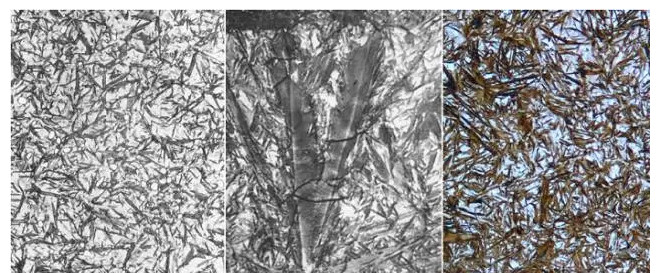
Needle martensiteAcicular martensite
Stainless steel weld X-ray flaw detection technology
Nickel-based alloy


